AI doesn't fail. Ungoverned content does.
When an AI assistant pulls from your documentation and serves a customer the wrong procedure, the failure didn't start with the chatbot. It started upstream, the moment two versions of the same topic existed and nobody controlled which one was authoritative. What follows is predictable: a support ticket, an escalation, and a content team combing through source files to find out which one actually went live.
For enterprise technical documentation teams, content governance has moved from a compliance checkbox to an operational requirement. The same documentation that used to live in a single help system now feeds chatbots, customer portals, internal knowledge bases, and AI-powered search simultaneously.
This article covers eight governance essentials for delivering consistent technical content across every delivery point, without the version drift and maintenance overhead that multi-channel publishing usually creates.
8 Governance Practices for Delivering AI-Ready Technical Content
1. Structured Content Architecture
AI systems don't reason their way to an accurate answer. They retrieve whatever matches the query, so the structure of your content determines the quality of the answer. Topic-based authoring in MadCap Flare separates content from presentation: product descriptions, procedures, and reference material get written once and reused across HTML5 outputs, PDF guides, and embedded help without reformatting.
That same structure is what SyndicateAI's semantic indexing depends on. Content published through SyndicateAI is analyzed and indexed automatically, and capabilities like Auto Classification and Content Maps use that structure to organize and enrich it, human-reviewed, not auto-published blind. Unstructured content gives an AI retrieval system nothing to index. Structured content gives it something to cite.
2. Single-Source Publishing
Version drift is a governance failure, not a technical inconvenience. When documentation exists as multiple copies in multiple places, nobody, including the AI system pulling from it, can tell which one is current. Single-sourcing in Flare solves this at the root: author once, and the publishing system generates every output from that one file.
Update the source, and the change flows to every destination. No manual rework across formats. No separate file per output to keep in sync. This is also what makes governance enforceable in the first place: you can't govern content you're maintaining in five different places.
3. Metadata Standards and Taxonomy
Metadata is the foundation AI-ready content is built on. Consistent tagging tells a retrieval system what content is about, who it applies to, and which product or version it covers. Without a taxonomy, an AI model surfaces incomplete or outdated results and has no way to know it.
Define tags for product, audience, content type, and lifecycle status, then apply them at the topic level. SyndicateAI Content Maps use semantic indexing to reveal how tagged content actually relates, and surface the gaps and redundancies a manual taxonomy review would miss.
5. Role-Based Access Permissions
Writers create and edit. Reviewers comment and approve. Administrators publish and manage permissions. Role-based access keeps each person inside their lane, so nobody accidentally overwrites approved content, and nobody outside the right group sees competitive documentation, internal procedures, or drafts that aren't ready for an external audience.
6. Content Scheduling and Classification
Documentation has a lifespan. Product versions change, features get deprecated, and content written for one release stops being accurate for the next. Governance means knowing when content should retire, not hoping someone remembers.
Content scheduling handles this automatically: SyndicateAI retires outdated material on a set date, typically tied to a deprecated product version, so a discontinued procedure doesn't sit in an AI-searchable portal next to the one that replaced it. Content classification adds a second layer, sorting material by sensitivity and regulatory requirement so restricted content never ends up in a public-facing AI channel by default. Together, they keep stale and sensitive material from ever reaching circulation instead of flagging it after the fact.
7. Omni-channel Delivery Controls
Your documentation reaches customers through self-service portals, embedded help, chatbots, partner applications, and support agent interfaces, each with its own formatting, permission, and audience requirements.
Delivering to that many surfaces without governance usually means a separate copy of the same content per channel, each maintained on its own schedule until they drift out of sync.
SyndicateAI manages variations from one governed hub: you define which content goes where, who can access it, and how it's formatted for each destination. One source, delivered consistently, instead of a separate content copy maintained per channel.
8. Analytics and Compliance Reporting
Governance requires visibility: which content gets used, which topics generate support escalations, and whether documentation meets what compliance requires. SyndicateAI is built to maintain 100% audit trail compliance by keeping a single version of the truth across every channel, backed by the ability to remove sensitive material immediately, everywhere, the moment it needs to come down.
Usage reports surface the gaps where customers search but don't find answers. Audit trails document the full approval history for regulated industries, exactly what an audit requires, without anyone rebuilding it from memory.
Why Governed Content Matters for AI Delivery
An AI system doesn't distinguish between current and outdated documentation. It retrieves whatever matches the query, including the wrong version. Governed content is what makes AI trustworthy: it ensures the system finds approved, trusted content.
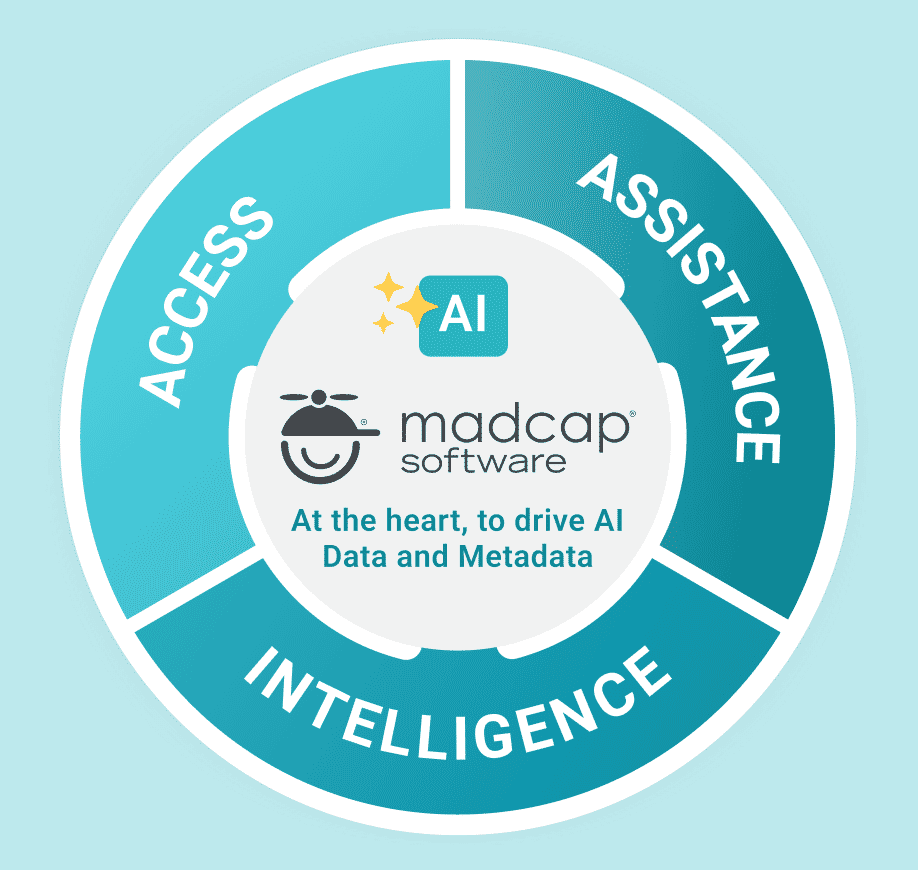
MadCap's approach connects the entire content lifecycle.
MadCap Flare and IXIA CCMS structure and author the content. MadCap SyndicateAI governs how it's delivered, to every channel, from one source, so an AI system, a support agent, and a customer looking at a portal are never reading three different answers.
Ready to see how governed delivery works for your technical documentation? Request a demo to explore how these governance essentials can fit your workflow.