This guide explains what causes content drift and how to prevent it through single-source governance, clear ownership, version control, and connected delivery. After reading, you’ll have a practical framework for keeping content consistent across documentation, training, support, and AI channels.
What Is Content Drift and Why Does It Affect Multi-Channel Publishing?
Content drift happens when the same information exists in multiple places and slowly diverges over time. Your LMS says one thing about a procedure. Your support portal says something slightly different. Your knowledge base has a third version. Your AI assistant confidently serves whichever outdated answer it finds first.
This is not just a content quality problem. It is a delivery problem. And it is where many knowledge strategies fail.
Preventing it requires more than a central repository. Organizations need a connected knowledge supply chain: governed content at the source, followed by controlled publishing and delivery to human and AI endpoints.
The root cause often sits upstream from your documentation. A process change gets announced in a team channel. A policy update lands in an email. A product release introduces new behavior. The systems holding your published content rarely find out until someone notices a customer complaint.
How Does Content Drift Damage Enterprise Documentation Teams?
Enterprise technical documentation teams face a specific version of this challenge. You are not managing a handful of pages. You are coordinating hundreds or thousands of topics across product lines, regions, languages, and delivery channels.
When drift enters your content ecosystem, the problems multiply. Training materials contradict support articles. Localized versions fall out of sync with their source. AI-powered search surfaces confident answers from superseded documents.
As content operations mature and expand, weaknesses in the delivery architecture become harder to ignore. More audiences, languages, products, and channels create more opportunities for unmanaged copies to diverge.
Each audience has different needs, permissions, and reasons for looking. Teams respond by creating more portals, more sites, and more copies of content tailored for each group.
Without a governed source and connected delivery model, that growth increases the risk of content drift.
For large documentation operations, MadCap IXIA CCMS provides DITA-based component management, structured reuse, version control, localization workflows, and lifecycle governance at enterprise scale.
Why Do Traditional Content Strategies Fail at Preventing Drift?
Many organizations try to solve content drift through discipline alone. They schedule quarterly reviews. They assign document owners. They implement checklists and approval workflows.
These efforts address symptoms rather than root causes. Manual review can reach only a portion of a large content library in any given cycle. By the time you finish auditing one section, other sections may have already drifted.
The fundamental issue is architectural. When you maintain separate copies of content for each delivery channel, you have created multiple sources of truth. Updates require touching every copy. Missing one creates drift.
What Is Single-Source Content Governance?
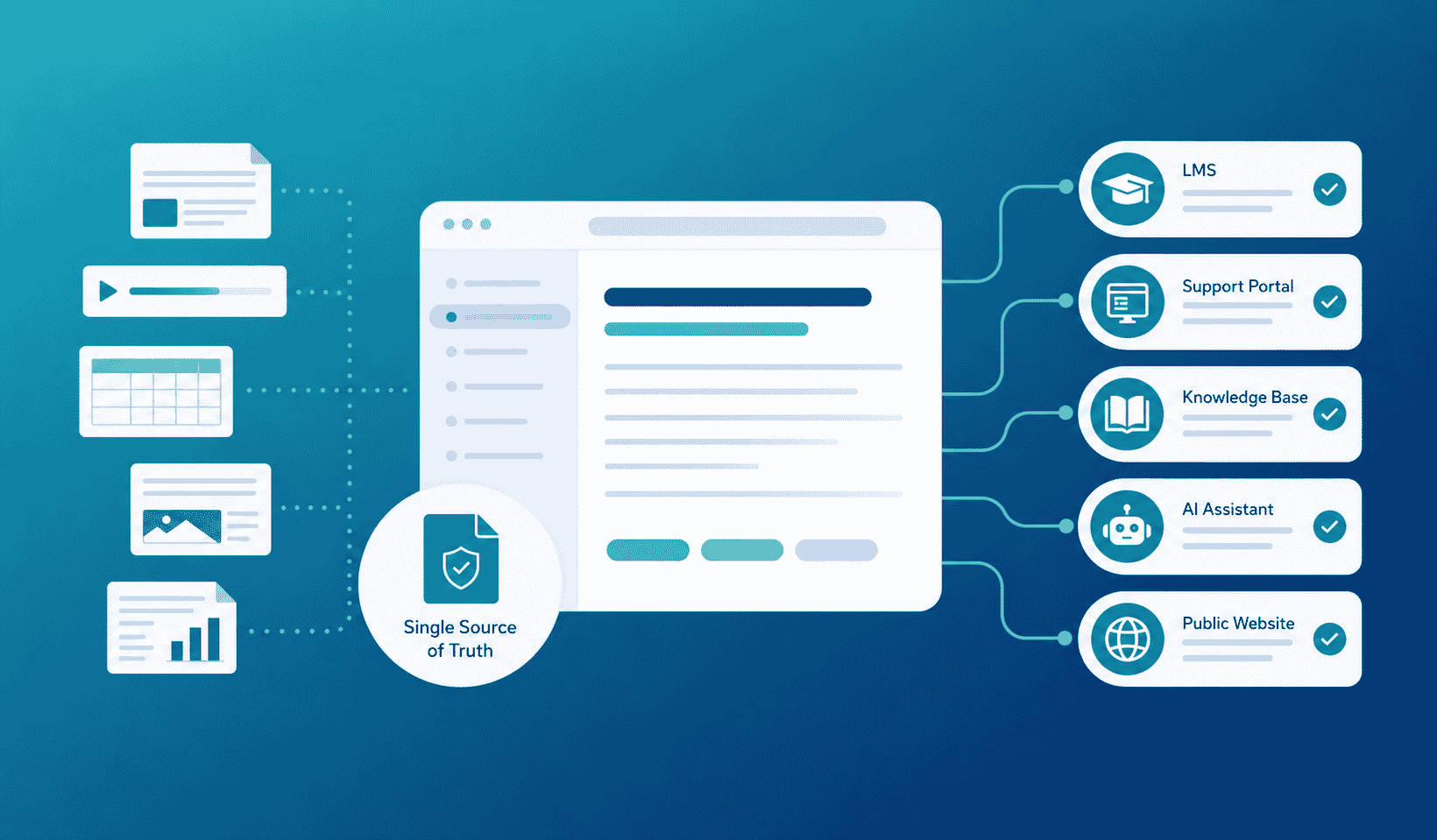
Single-source governance inverts the traditional model. Instead of maintaining multiple copies that need synchronization, you maintain one authoritative version that can be published across channels.
The concept is not new. Technical documentation teams have used single-source authoring for decades. What has changed is the delivery landscape. Your content now needs to reach LMS platforms, support portals, public knowledge bases, internal wikis, chatbots, and AI assistants.
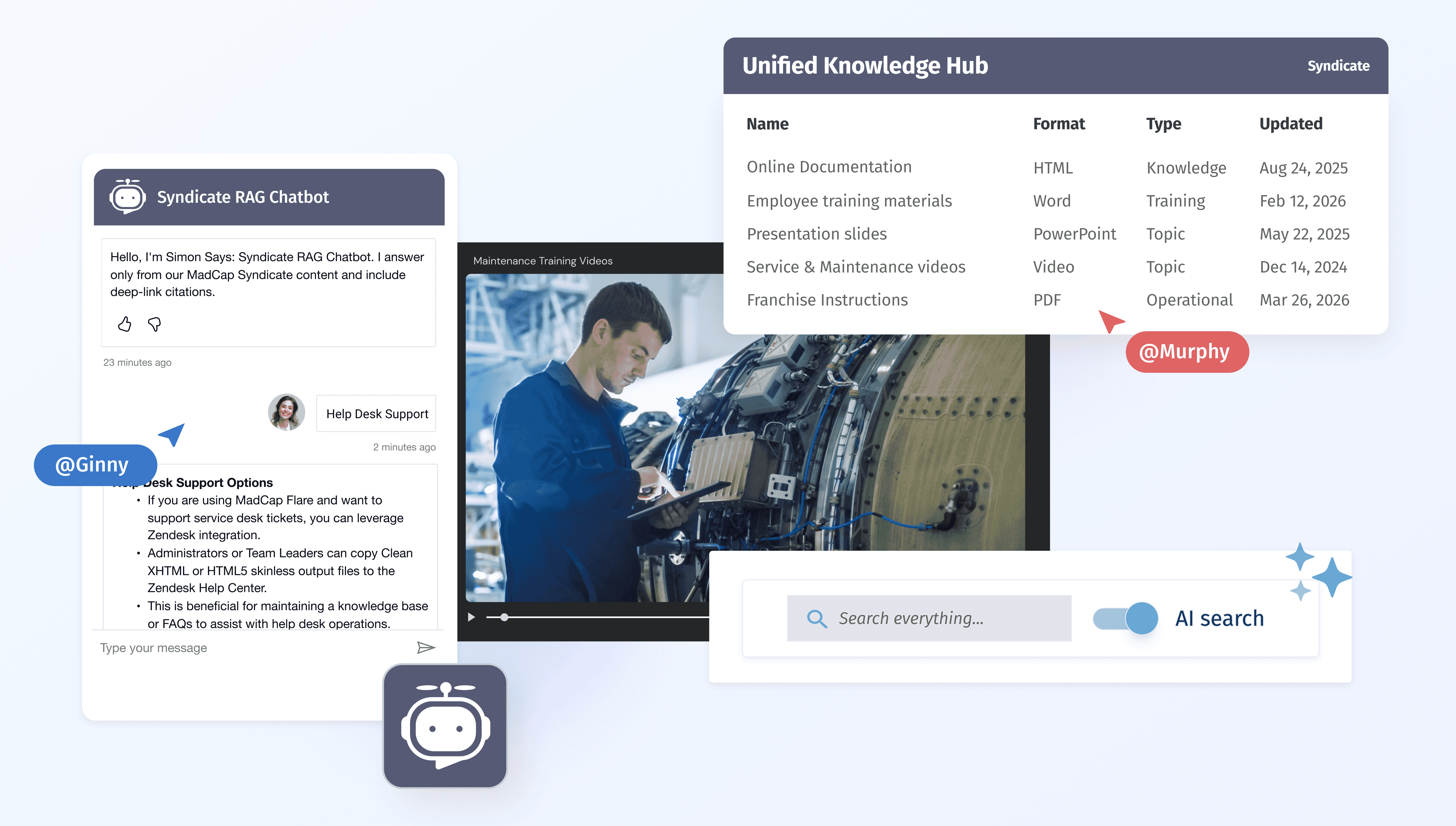
A governance framework addresses this by separating content from presentation. Your source content lives in a controlled location with version management, review processes, and defined ownership. Publishing and delivery workflows transform or distribute that content according to the requirements of each endpoint.
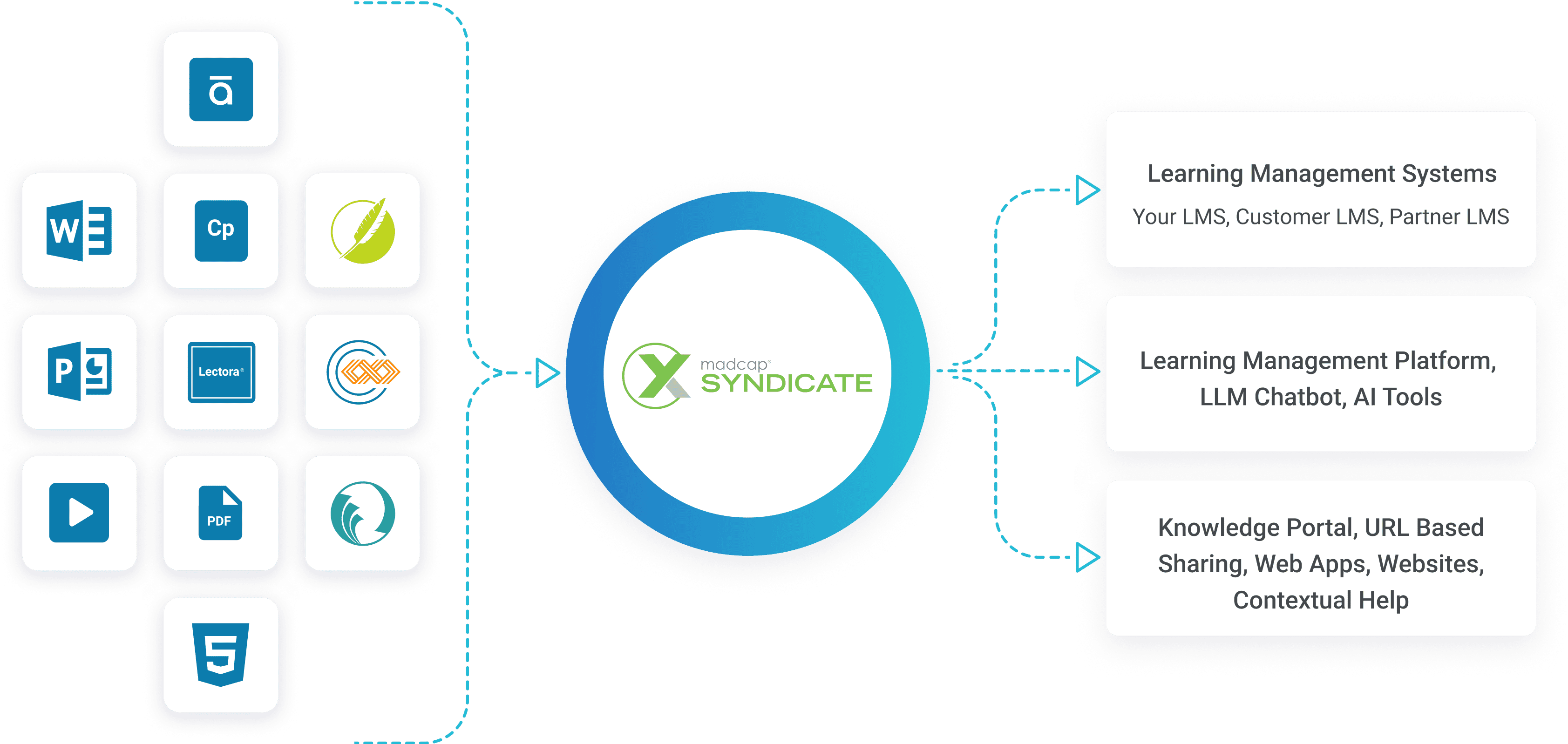
Within the MadCap platform, Flare supports flexible topic-based technical authoring and multichannel publishing. IXIA CCMS provides enterprise DITA governance for complex documentation operations. MadCap Create applies structured, reusable authoring to learning and enablement content. MadCap SyndicateAI connects governed content to portals, enterprise systems, search experiences, and AI applications.
How Does Single-Source Publishing Eliminate Version Drift?
When you publish from a governed source, updates happen once at the content level. Connected channels can then receive those changes through consistent, controlled workflows.
Static outputs may still be required, particularly for PDF, Word, SCORM, or regulated deliverables. The difference is that those outputs are generated from the governed source rather than maintained as independent content copies.
SyndicateAI provides the delivery and activation layer for governed content. It connects documentation, learning, product, and support content to portals, enterprise systems, search experiences, and AI applications.
Approved updates can be delivered across connected endpoints through configured publishing, API, and access workflows.
Your team can focus on content accuracy at the source while the delivery infrastructure manages distribution.
What Are the Core Components of a Content Governance Framework?
Building a drift-resistant system requires four foundational elements working together.
Clear Content Ownership
Every piece of content needs a designated owner responsible for accuracy. When ownership is unclear, updates stall. Nobody feels accountable for catching drift.
Ownership should map to domain expertise. Engineering owns technical specifications. Support owns troubleshooting guidance. Training owns onboarding materials. Cross-functional content needs explicit agreements about who approves what.
Channel ownership should also be separated from source ownership. One team may own the accuracy of a product procedure, while another team controls how that procedure appears in a support portal or LMS.
Version Control and Change Tracking
You cannot prevent drift if you cannot see what changed, when it changed, and who changed it. Version control creates the audit trail that makes governance possible.
This means more than saving files with date stamps. You need systems that track granular changes, support rollback, and maintain history across the content library.
For complex content environments, look for systems that provide visibility into references, reuse relationships, and dependencies so teams can evaluate the downstream impact of a change.
Review Cycles Tied to Business Triggers
Calendar-based reviews often miss context. A document might need updating after a product release, policy change, regulatory update, or support escalation pattern, not simply because three months have passed.
Effective governance connects review triggers to business events. Product launches prompt documentation reviews. Support ticket clusters trigger content audits. Regulatory changes initiate compliance reviews.
Automated Publishing Workflows
Manual publishing introduces human error at the moment content reaches your audience. Someone forgets a channel. Someone publishes a draft instead of the approved version. Someone updates production without completing the required review.
Automation removes many of these failure points. Approved content moves through defined workflows. Connected channels receive updates according to configured rules rather than individual memory.
Technology can govern and distribute approved content, but it cannot identify every policy, product, or process change that occurs outside the content workflow. Clear ownership and business-triggered reviews remain necessary.
How Do You Implement Single-Source Governance for LMS Content?
Learning management systems present specific governance challenges. Training content often needs versioning for compliance purposes. Learners access materials through course structures that may reference multiple content sources.
Start by auditing how content currently flows into your LMS. Many organizations discover they are importing static exports that immediately begin drifting from their source.
MadCap Create gives learning and development teams a structured authoring environment for building reusable courseware, training manuals, assessments, and performance support content. The same governed components can be published into formats such as SCORM, responsive HTML, PDF, Word, and PowerPoint rather than recreated for each learning experience.
MadCap SyndicateAI extends that model by delivering governed learning content to LMS, LXP, HRIS, portal, and AI environments through supported publishing and integration workflows.
Depending on the delivery model, governed learning content can be updated through connected workflows rather than manually recreating and re-importing content for every destination.
What Does Governance Look Like for Support Portals?
Support portals face constant pressure to stay current. Product changes, known issues, and workarounds need rapid publication. That urgency often bypasses governance, creating drift between support content and other channels.
Single-source delivery makes rapid publication compatible with governance. You update and approve the source once. The support portal receives the update through a controlled publishing or delivery workflow.
MadCap Flare gives technical documentation teams a common source for responsive web, print, mobile, and other outputs. For connected delivery, Flare Online can publish directly to MadCap SyndicateAI, where the content can support governed portals, semantic search, analytics, and authorized AI experiences without creating a separately maintained support copy.
How Should You Govern Knowledge Base Content?
Knowledge bases serve both internal and external audiences, often from the same underlying information. Internal teams may need complete troubleshooting details and escalation paths. External audiences need customer-appropriate versions of similar material.
Governance here requires conditional publishing. Your single source contains the complete information with appropriate tagging. Publishing and access rules determine what each audience sees. Updates flow to both audiences from the same managed content.
In Flare, conditional content and reusable topics help teams produce audience-specific outputs from a common source. In SyndicateAI, role-based access, metadata, classifications, and portal configurations help determine which users and applications can access content.
This eliminates the common pattern where internal and external knowledge bases diverge over time because different teams own different copies.
Effective version control for multi-channel content goes beyond file-level tracking. Teams need visibility into the history of individual topics or components, how content is reused, and where a change may have downstream effects.
The appropriate versioning model depends on the size and complexity of the content operation. Flare and Flare Online support topic-based technical authoring and collaborative content management. IXIA CCMS adds enterprise DITA component governance, granular history, complex lifecycle management, and traceability for large or regulated content environments.
This becomes critical in regulated industries where audit requirements demand proof of content accuracy at specific points in time.
How Do You Build Review Workflows That Actually Prevent Drift?
Review workflows fail when they create too much friction for routine updates or lack sufficient controls for significant changes. Effective workflows calibrate review requirements to the impact of the change.
Minor editorial corrections might need only author self-review. Procedural changes need subject matter expert validation. Compliance-sensitive content may need legal, quality, or regulatory review.
The key is making appropriate review the path of least resistance. When bypassing review requires more effort than following the process, people are more likely to follow the process.
What Ownership Models Work for Cross-Channel Content?
Content that appears across multiple channels often falls between organizational boundaries. Marketing owns the website. Training owns the LMS. Support owns the knowledge base. Who owns the product description that appears everywhere?
Successful governance assigns source ownership separately from channel ownership. One team owns content accuracy. Channel teams own the appropriate presentation and experience for their audience.
This model requires clear agreements about update authority. Channel teams can request changes. Source owners approve and implement them. Nobody makes direct edits to an independently maintained channel copy.
How Do You Detect Drift Before It Reaches Customers?
Prevention matters more than detection, but detection remains necessary. Content changes happen outside your governance system. Products ship features before documentation catches up. Processes change before anyone updates the training.
Detection strategies work in three layers.
- Behavioral Signals surface when people stop trusting your content. Support ticket patterns might indicate customers are finding outdated instructions. Escalation rates might spike around specific procedures.
- Quantitative signals track content freshness and usage. Documents that have not been reviewed within expected cycles need attention. High-traffic content with stale review dates creates additional risk.
- Structural signals identify governance gaps. Missing ownership assignments, orphaned documents, broken references, and incomplete review schedules indicate systemic drift risk.

What Technologies Support Single-Source Governance?
The right documentation technology makes good workflows sustainable.
Different content teams may require different authoring and governance models.
Flare supports topic-based technical documentation, content reuse, conditional publishing, and multichannel output.
IXIA CCMS provides enterprise DITA component management for large, complex, multilingual, or regulated documentation operations.
Create gives learning and enablement teams structured, reusable content development for courses, manuals, assessments, and performance support.
SyndicateAI serves as the delivery layer. It connects governed content from authoring environments to portals, enterprise platforms, search experiences, analytics, and AI applications.
For organizations managing localization at scale, IXIA CCMS helps govern source and translated components through structured localization workflows. Integration with MadTranslations provides a connected path for managing translation work within the broader content lifecycle.
How Do You Handle Legacy Content During Governance Implementation?
Most organizations do not start with a clean slate. Existing content lives in scattered locations with inconsistent quality and unknown ownership. Migration requires prioritization.
Start with content that creates the most risk when it drifts. Customer-facing procedures, compliance-sensitive materials, and frequently referenced guides deserve early attention.
Move high-priority content into your governed system first. Establish ownership, implement version control, and connect publishing workflows. Expand gradually rather than attempting a complete migration at once.
This approach also creates an opportunity to eliminate duplicates, archive obsolete content, and determine which information should not be carried into the new environment.
What Common Mistakes Undermine Governance Implementations?
Governance initiatives fail for predictable reasons.
- Over-engineering approval processes creates delays that push people to work around the system. When simple changes take weeks to approve, authors find shortcuts.
- Ignoring cultural factors leads to technical solutions without adoption. If teams do not understand why governance matters, they will view it as bureaucracy rather than protection.
- Treating governance as a project rather than an ongoing practice means energy fades after the initial implementation. Governance requires continued attention, not a one-time effort.
- Underestimating maintenance requirements leaves systems working initially but degrading over time. Ownership assignments need updating as teams change. Review schedules need adjustment as content volumes grow.
How Do You Measure Governance Effectiveness?
Governance success appears in operational metrics.
- Time to publish updates should decrease as workflows become established. If governance adds significant time to routine changes, the process may need adjustment.
- Drift incidents should decline over time. Track cases where customers or internal teams encounter outdated or conflicting content. The trend matters more than the absolute number.
- Review compliance indicates process health. What percentage of content receives scheduled reviews? How often do reviews happen on time rather than requiring escalation?
- Support ticket patterns reveal content gaps. Tickets referencing unclear, outdated, or contradictory documentation suggest governance failures are reaching customers.
- Content reuse can also indicate whether teams are relying on governed components or continuing to create independent copies. Higher reuse does not automatically prove effective governance, but low reuse may expose duplication risk.
What Does Mature Content Governance Look Like?
Mature governance becomes nearly invisible. Teams create and update content through established workflows without treating governance as a separate activity.
Ownership is clear and current. Version control captures changes automatically. Reviews happen when appropriate triggers occur. Publishing reaches connected channels from governed sources.
Drift may still happen occasionally, but detection catches it quickly. Recovery happens through rollback and correction rather than crisis management.
The organization can answer questions about content status at any point in time. Auditors can see what was approved and published. Support teams can confirm what customers saw during a specific incident. AI applications can be limited to authorized, governed content that meets the organization’s publishing and access requirements.
Conclusion: Building Governance That Scales with Your Content Demands
Content drift is not inevitable. It is the predictable outcome of maintaining multiple content copies without systematic governance.
Single-source publishing reduces the category of errors where information diverges because different teams manage different copies. Governance frameworks add the ownership, version control, review processes, and access controls that keep the source accurate.
The investment pays returns across your operation. Support teams answer from current information. Training materials match actual procedures. AI assistants retrieve governed content rather than outdated artifacts.
Your organization is already creating valuable content. Documentation, training, enablement, and knowledge assets accumulate through ongoing effort. What is missing for many teams is the delivery layer that keeps those channels aligned.
MadCap Flare, IXIA CCMS, and Create provide authoring and governance environments designed for different content teams and levels of complexity. MadCap SyndicateAI extends that governed content to portals, enterprise systems, search experiences, and AI experiences.
Building that connected knowledge supply chain requires treating content delivery as infrastructure rather than an afterthought. The tools exist. The remaining question is whether your organization commits to the governance practices that make consistent multi-channel publishing possible.
Preventing content drift requires more than better review processes. It requires a governed source of truth and a delivery layer that keeps every channel aligned as content changes.
MadCap SyndicateAI helps organizations distribute trusted content across portals, enterprise systems, search experiences, and AI applications without requiring teams to maintain separate source copies for every destination.
If you're evaluating a content infrastructure decision and want to see how MadCap addresses this in practice, schedule a conversation with our team.
Frequently Asked Questions
What is content drift in multi-channel publishing?
Content drift occurs when the same information exists in multiple channels and gradually diverges over time. This happens when teams maintain separate copies in LMS platforms, support portals, and knowledge bases rather than publishing from a governed source. MadCap SyndicateAI helps address this problem by distributing governed content to connected portals, systems, and AI applications through controlled publishing and access rules.
Why is content drift more dangerous for AI-powered systems?
AI assistants retrieve and present information without reliably knowing whether organizational content is still current, approved, or appropriate. Structured, topic-based content from MadCap Flare or IXIA CCMS gives retrieval systems more focused information to work with. MadCap SyndicateAI semantically indexes governed content and makes individual topics available to authorized AI applications.
How do I know if my organization has a content drift problem?
Common indicators include support tickets referencing outdated procedures, training materials that contradict current processes, conflicting information across portals, and AI assistants returning incorrect answers. Track how often customers or internal teams encounter inconsistent information across channels to understand the scope.
What is the difference between single-source authoring and single-source governance?
Single-source authoring means creating content once for multiple outputs. Single-source governance adds ownership, version control, review cycles, access rules, and controlled publishing processes that help prevent drift.
The MadCap platform supports both source governance and controlled delivery. Flare supports topic-based technical authoring, IXIA CCMS provides enterprise DITA governance, and Create supports structured learning content. SyndicateAI activates governed content across portals, enterprise systems, search experiences, and AI applications.
Can I implement governance gradually or does it require a complete overhaul?
Gradual implementation works better for most organizations. Start with high-risk content that causes the greatest problems when it drifts. Establish ownership, implement version control, and connect publishing workflows for priority content first. Expand systematically rather than attempting a complete migration at once.
How often should governed content be reviewed?
Review frequency should connect to business triggers rather than arbitrary calendars alone. Product releases, policy changes, regulatory updates, and support escalation patterns indicate when content needs attention. High-traffic or compliance-sensitive content may also require scheduled reviews more frequently than stable reference material.
What role does version control play in preventing content drift?
Version control creates the foundation for governance by tracking what changed, when it changed, and who changed it. Without that visibility, teams cannot reliably identify when drift began or return to a known-good state. MadCap IXIA CCMS provides component-level version management for granular change tracking across structured content libraries.