AI-ready content is content that is structured, accurate, centrally governed, and machine-retrievable, so AI tools can surface correct answers from it. AI has the potential to reshape how software and technology companies deliver knowledge. From accelerating developer onboarding to powering AI-driven support experiences or rolling out updated product documentation across global teams, the possibilities are enormous. But realizing that potential starts with one thing: content that’s structured, accurate, and accessible.
That’s where many software organizations still face challenges. While most teams rely on tools like internal wikis, shared drives, or outdated documentation portals, critical content is often scattered, redundant, or version-conflicted. When knowledge isn’t consistently structured or centrally governed, AI tools struggle to surface the right answers. This results in confusion, support delays, and wasted investments.
This was a central theme in MadCap Software’s 4-part AI webinar series, where industry experts emphasized that AI is only as effective as the content ecosystem it operates within. Without well-structured, centralized, and governed content, AI risks delivering outdated, misleading, or irrelevant results.
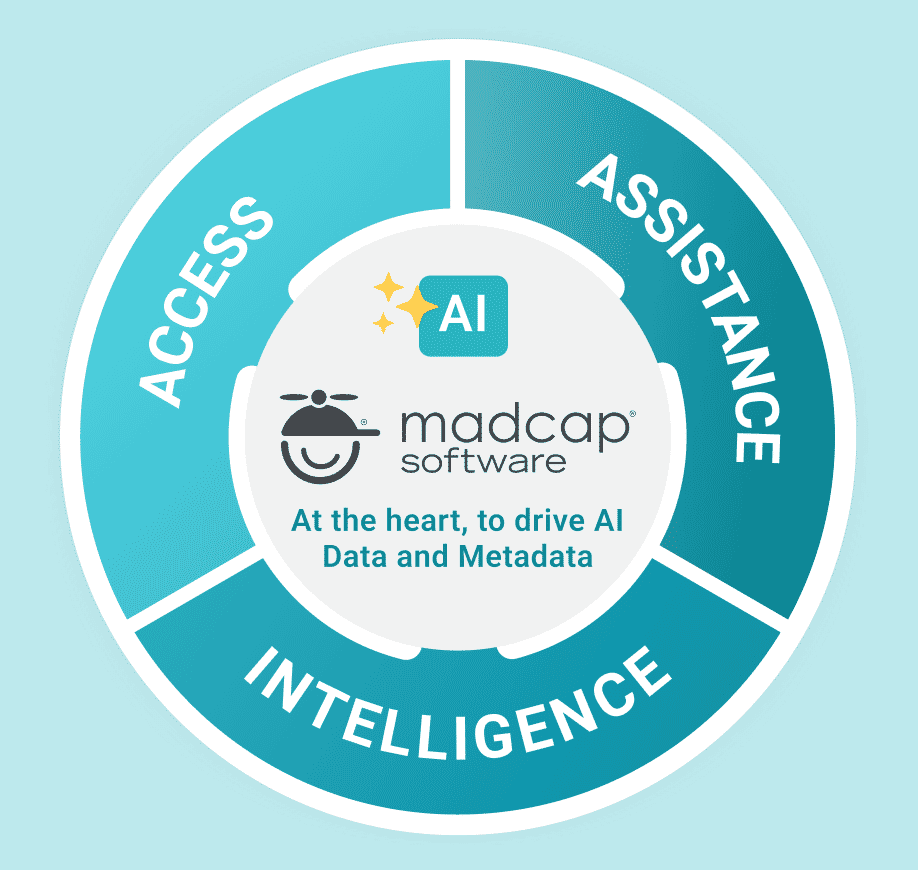
So, how can organizations ensure AI drives real value? By focusing on three core pillars: Content Access, Content Intelligence, and Content Assistance—each playing a critical role in how AI retrieves, analyzes, and enhances content.
What Makes Content AI-Ready?
Content is AI-ready when it is structured, accurate, centrally governed, and machine-retrievable. Four properties matter most: it is structured into consistent topics, it is accurate and current, it is centralized in a single source of truth, and it is governed with clear ownership. The three pillars below show how AI then accesses, analyzes, and helps create that content.
How Does AI Access Your Content?
AI can only use content it can reach. It needs direct, permissioned access to your structured internal content, or it will guess and return outdated or fabricated answers.
The Challenge: AI Can’t Use What It Can’t Access
AI models, including large language models (LLMs), are trained on vast datasets—but they don��t automatically understand an organization’s proprietary knowledge. Without direct access to structured internal content, AI can’t deliver reliable, context-aware responses. Instead, it may fabricate information or default to generic answers.
A common scenario: employees search for updated policies or training materials and receive outdated or irrelevant results because the AI lacks access to verified internal documentation.
How Retrieval-Augmented Generation (RAG) Prevents AI Hallucinations
Retrieval-Augmented Generation (RAG) strengthens AI by pulling relevant content from an organization’s internal repository before generating a response. Rather than relying solely on pre-trained data, RAG enables AI to:
- Access structured, trusted sources before answering queries
- Ground responses in real, verified content
- Deliver contextually accurate information based on internal knowledge
AI-Powered Access in Action: MadCap Create, MadCap Flare, and MadCap SyndicateAI
To unlock the full potential of RAG and AI-powered search, organizations must first structure their content for seamless retrieval. This begins with MadCap Create (formerly Xyleme LCMS) and MadCap Flare, each serving distinct content authoring needs:
- MadCap Create specializes in eLearning and instructional content, ensuring training materials are metadata-tagged, structured, and AI-ready.
- MadCap Flare is built for technical documentation, policies, and help guides, supporting structured authoring for multi-channel publishing.
Once content is structured, content is pushed to MadCap SyndicateAI, where it benefits from:
- AI-powered retrieval, enhanced metadata tagging, and semantic search
- Syndication across enterprise search engines, knowledge bases, and AI tools
- Centralized governance to ensure consistency across all documentation
By integrating MadCap Create and Flare with MadCap SyndicateAI, organizations ensure their content—both training and technical—is AI-ready, easily retrievable, and fully optimized for semantic search.
How Does AI Make Your Content More Usable?
AI makes content usable by analyzing, structuring, and classifying it, so the right information surfaces on demand instead of staying buried.
AI doesn’t just improve access to content—it transforms how organizations analyze, structure, and refine information. Without AI-driven insights, many companies face content overload, where employees waste time digging through duplicate, outdated, or buried materials.
This lack of visibility leads to content chaos: teams unknowingly recreate existing resources or miss critical gaps. AI-powered content intelligence addresses this by identifying valuable, outdated, or redundant content—enabling organizations to curate, refine, and maintain a streamlined knowledge base backed by data.
But insight alone isn’t enough. To make content usable, it must remain structured, searchable, and easy to surface when needed.
Smarter Search, Tagging, and Classification
Traditional search depends on exact keyword matches, often returning incomplete or irrelevant results. AI-powered semantic search improves discoverability by understanding user intent—even when phrasing doesn’t match document titles or metadata.
AI also enhances:
- Content Clustering – Groups related materials by theme, topic, or context to reveal patterns, reduce redundancy, and improve navigation.
- Content Classification – Automatically applies structured categories and metadata to ensure consistency and simplify retrieval across repositories.
These AI capabilities help organizations:
- Apply metadata at scale for better searchability
- Maintain consistent labeling across systems
- Automatically categorize content based on context and meaning
However, to fully leverage AI-driven search, clustering, and classification, a structured content ecosystem is essential—one that keeps information organized, accessible, and AI-ready.
MadCap Solutions for AI-Driven Content Intelligence
MadCap Create and Flare structure content at the authoring stage, while MadCap SyndicateAI takes it further—enhancing metadata, enabling AI-powered search, and optimizing content for discoverability across enterprise platforms.
Key capabilities of MadCap SyndicateAI include:
- Semantic search that retrieves relevant content based on user intent—not just exact text matches
- Metadata tagging to organize and classify content for easier search and retrieval
- Content usage analytics that reveal how content is accessed and used
To support continued innovation, the MadCap AI Lab—MadCap’s research hub for AI-driven features—is developing advanced capabilities, including:
- AI-powered metadata tagging to automate classification at the point of ingestion, ensuring consistency and reducing manual effort
- Advanced semantic analysis and vector-based retrieval to surface deeper content relationships and improve knowledge discovery
- Duplicate content analysis to identify and consolidate redundant materials, streamlining content ecosystems
With structured, AI-ready content in place, the next step is using AI to support content creation and refinement—enabling teams to work more efficiently without sacrificing accuracy or control.
How Does AI Help Create and Maintain Content?
AI helps teams create and maintain content by accelerating repetitive tasks, so writers focus on strategy, accuracy, and structure.
For many organizations, the challenge goes beyond organizing content—it’s creating, refining, and maintaining it at scale. AI is transforming workflows, not by replacing writers and instructional designers, but by accelerating repetitive tasks, so teams focus on strategy, creativity, and precision.
Rather than battling blank pages or manual formatting, AI helps teams generate, refine, and optimize content efficiently—while maintaining governance and brand consistency.
AI-Powered Content Optimization with MadCap Sidekick and MadCap Flare Online
As AI becomes integral to content workflows, on-demand assistance is no longer optional—it’s essential for streamlining creation, refinement, and optimization. MadCap Software embeds AI-driven capabilities directly into MadCap Sidekick and MadCap Flare Online, helping teams increase efficiency while maintaining editorial control.
- MadCap Sidekick offers a flexible AI toolkit for summarizing content, generating assessments, and refining documents with customizable AI-powered actions.
- AI Assist in MadCap Flare Online brings ChatGPT-based capabilities into cloud authoring, supporting drafting, rewriting, and editing with built-in security controls.
How Do You Keep AI Use Secure and Governed?
You keep AI secure by controlling what it can access. Opt-in features, support for private models, and user-level permissions keep proprietary content protected.
As organizations increasingly rely on AI for content creation and management, security, privacy, and governance must remain top priorities. While AI introduces powerful efficiencies, it also poses risks to proprietary and sensitive information if not properly managed.
MadCap’s approach emphasizes secure, controlled adoption—ensuring organizations retain full authority over how AI interacts with their content. Key security measures include:
- Opt-in AI Features – AI Assist does not automatically process entire documents. Users must explicitly enable AI interactions and select specific content, preventing unrestricted access.
- Support for Private AI Models – Organizations can integrate their own private ChatGPT accounts, ensuring proprietary content stays outside public AI systems.
- Strict API Controls and User Permissions – AI Assist needs an OpenAI API key, allowing only authorized content to be processed. Usage can also be enabled or restricted at the user level to support robust content governance.
The AI-Ready Content Checklist
Content is AI-ready when it meets these criteria:
- Content is structured with consistent topics, not free-form documents.
- A single source of truth exists for each topic, with no conflicting versions.
- Metadata and taxonomy are applied consistently.
- Content is centrally governed with clear ownership.
- Outdated and duplicate content is identified and retired.
- Content is machine-retrievable through structured formats.
- Access and security permissions are defined before AI is connected.
See how MadCap SyndicateAI makes content retrievable for AI.
AI-Driven Success Starts with Content Strategy
AI is more than a tool—it’s a transformation in the way we work. Even the best systems will fall short without a solid content foundation and a clear content strategy.
MadCap helps teams build structured, governed workflows that support discoverability, consistency, and scalability—across authoring, governance, and delivery.
Talk to the MadCap team about AI-ready content.
Organizations that invest in AI-ready content today won’t just catch up. They’ll lead the way in intelligent content management.
Want to Dive Deeper? Explore the full AI webinar series for expert insights and practical guidance on building an AI-ready content ecosystem:
Episode 1: Preparing for AI in Content Development and Management
Episode 2: Preparing for AI in Content Development and Management: Content Access
Episode 3: Preparing for AI in Content Development and Management: Content Intelligence
Episode 4: Preparing for AI in Content Development and Management: Content Assistance
Frequently Asked Questions
What is AI-ready content?
AI-ready content is content that is structured, accurate, centrally governed, and machine-retrievable. These properties let AI tools find and surface the right information reliably. Unstructured or scattered content forces AI to guess, which produces outdated or fabricated answers.
How do I know if my content is AI-ready?
Check whether your content is structured, governed by a single source of truth, consistently tagged with metadata, and free of duplicate or outdated material. If knowledge is scattered across wikis, drives, and old portals, it is not yet AI-ready.
Why does AI give wrong or outdated answers?
AI gives wrong answers when it cannot access verified, current content. Without retrieval from a trusted internal source, a model defaults to generic training data or fabricates a response. Grounding AI in structured, governed content prevents this.
What is retrieval-augmented generation (RAG)?
RAG is a method that pulls relevant content from an organization's trusted repository before the AI generates an answer. It grounds responses in real, verified content instead of relying only on pre-trained data, which improves accuracy and reduces hallucinations.
Does AI replace technical writers?
No. AI accelerates repetitive tasks like drafting, summarizing, and formatting, so writers focus on strategy, accuracy, and structure. The quality of AI output still depends on well-structured source content and human editorial control.
Where should a software company start?
Start by structuring and governing existing content before adding AI tools. Centralize sources, remove duplicates, apply metadata, and define ownership. A structured authoring foundation in tools like MadCap Flare and MadCap Create makes later AI retrieval reliable.