Structured Content Is No Longer Just for Documentation Teams
Most people think of structured content as the domain of technical writers. But many enterprises now see it differently. As a strategic asset. One that extends far beyond manuals and help centers.
By breaking content into reusable, modular pieces, organizations can deliver consistent messaging across product, marketing, and support. The result is smoother onboarding, clearer UIs, stronger self service portals, and more seamless experiences across every customer touch point.
Why Consistency and Reuse Matter to Customers
Customers rarely stay in one place. They move between apps, websites, emails, and support portals, sometimes within the same interaction. When messages conflict or instructions vary, frustration builds quickly. Over time, those inconsistencies weaken trust and customer loyalty.
Structured content creates a single source of truth. Customers get accurate, reliable guidance wherever they engage with your brand.
Product UIs and in-app guidance
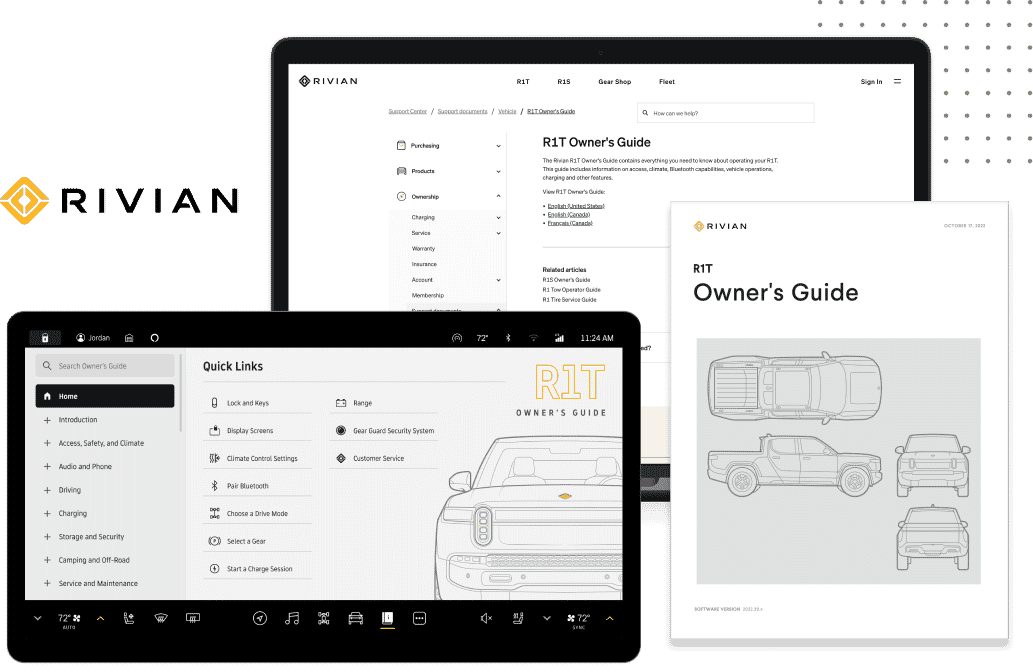
Traditionally, launching a new feature meant rewriting guidance for every context: app screens, onboarding flows, notifications, emails, and help content. The process was repetitive, expensive, and prone to errors.
Write once. Reuse everywhere.
With structured content, updates flow across channels automatically. Customers see the same message in the product, in an email, or inside a help article. That consistency accelerates adoption and strengthens confidence in the product experience.
Support portals and self-service journeys
Customers already arrive frustrated. Digging through static support articles often make things worse.
Structured content powers dynamic, searchable support experiences that surface accurate, personalized answers. Whether customers engage in English, Spanish, or Japanese, they can find the right information quickly. Support teams spend less time answering repetitive questions and more time resolving complex issues.
Breaking Down Silos Between Documentation, Product, and Marketing
In many organizations, the same information gets rewritten repeatedly for product, documentation, and marketing teams. The result is duplication, inconsistency, and unnecessary effort.
Structured content changes the model.
Teams work from a shared repository of reusable components, which keeps messaging aligned, reduces errors, and improves collaboration across departments.
The problem with copy-paste culture
It starts small. A product name changes in marketing but remains outdated in the support center. Soon customers encounter conflicting information across channels. What looked efficient at first becomes a tangled system of inconsistencies.
Shortcuts create long term problems.
Structured content as a shared language
Reusable modules create a common vocabulary across teams. A single compliance update can instantly refresh user manuals, in app warnings, onboarding flows, and support portals. Alignment no longer depends on manual coordination. It becomes part of the system itself.
From Static Docs to Dynamic CX Assets
Customer expectations keep rising. People expect answers to be immediate, contextual, and personalized.
Structured content meets those expectations by turning static documentation into adaptive customer experience assets. One article can power a chatbot, surface inside the product, appear in a knowledge base, or support AI driven experiences. The content adapts to the moment without being recreated each time.
How MadCap IXIA CCMS Supports the Full Customer Journey
Consistency at scale takes structure. Good intentions are not enough.
MadCap IXIA CCMS helps enterprises:
- Create content once and reuse it across digital channels
- Maintain accuracy and consistency at every customer touch point
- Simplify collaboration with governance and review workflows
- Accelerate localization through reusable multilingual content
- Prepare content for AI with structured metadata and intelligent architecture
By adopting IXIA, teams stop rebuilding the same content across product, support, and marketing. Information stays aligned across channels, updates move faster, and customers encounter fewer conflicting messages.
Your customers deserve clarity everywhere. Make every interaction consistent.