






Today’s global economy is in a state of flux, and economic uncertainty and volatility are at an all-time high. The need for agility and adaptability is greater than ever, making it essential for organizations to invest in learning and development (L&D) to remain competitive and keep up with the pace of intelligent content development.
The importance of L&D is reflected in predictions from Allied Market Research that the global corporate training market will reach $805.6 billion by 2035, nearly double its 2023 value of $361.5 billion, driven in part by rapid technology advances and the need for upskilling/reskilling.
At the same time, concerns around inflation and shrinking purchasing power can make it difficult for L&D teams to secure learning and development budgets or justify buying a learning content management system (LCMS). A learning content management system is a platform that integrates the authoring, management, delivery, and analysis of learning content in a single, multi-user environment. Despite these concerns, the LCMS has become a gamechanger for learning, and it’s essential to understand why investing in an LCMS is more critical now than ever. Let’s look at the top three considerations.
In short, an LCMS is worth the investment because it lets teams embrace an intelligent content strategy, do more with less, and gain visibility into content performance.
1. Embrace an Intelligent Content Strategy: Take a Crawl, Walk, Run Approach
One of the challenges that content teams face is keeping pace with intelligent content development. Intelligent content is a type of content that is structured, modular, reusable, and semantically rich. It is designed to be easily discoverable, adaptable, and personalized. Intelligent content is a foundational requirement for enabling artificial intelligence (AI) to generate content and search responses that are both accurate and relevant.
Intelligent content can help organizations improve their content creation, management, and delivery processes, and provide better customer experiences across multiple channels and devices. However, implementing an intelligent content strategy can be daunting, especially for organizations that have a large amount of unstructured content, legacy systems, and siloed teams. To overcome these challenges, organizations should take a crawl, walk, run approach to embrace intelligent content strategy.
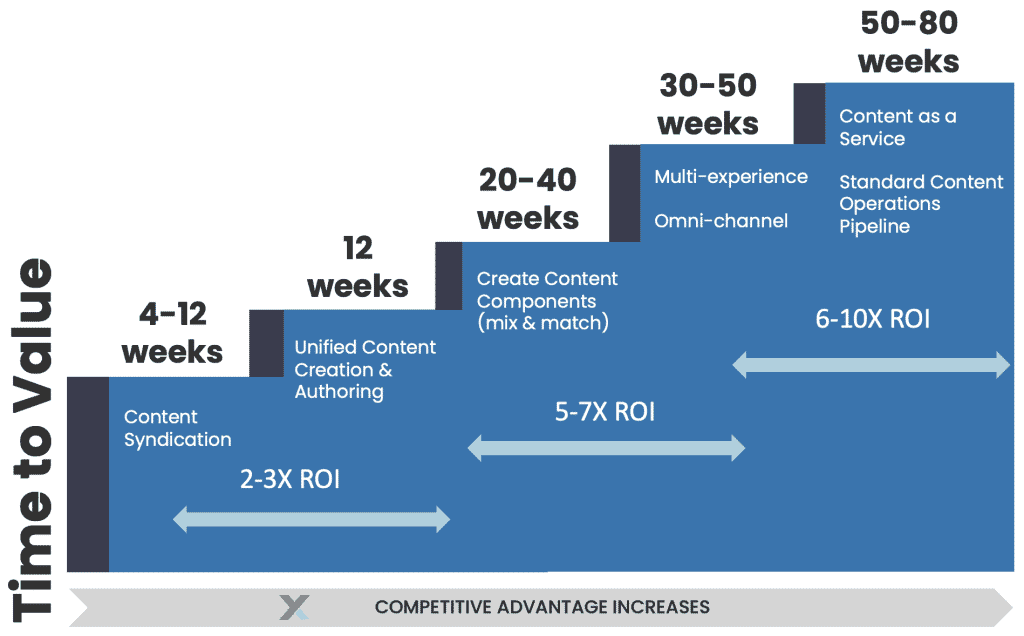
Focus on the Business Value:
The first step in embracing an intelligent content strategy is to focus on business value. Intelligent content should not be an end, but a means to achieve your business objectives. Therefore, you should align your intelligent content initiatives with your business outcomes, such as revenue growth, cost reduction, customer satisfaction, or brand awareness.
To measure the business value of your intelligent content initiatives, you should define relevant metrics, such as conversion rates, engagement rates, retention rates, or referral rates. It’s also important to establish a feedback loop that allows you to continuously improve your intelligent content strategy based on user feedback, analytics, and market trends.
Start from where you are, not where you want to be!
The second step in embracing an intelligent content strategy is to assess your current content ecosystem. This includes identifying your content types, formats, sources, and channels, as well as your content creation, management, and delivery processes. You should also evaluate your content governance, metadata, taxonomy, and analytics capabilities. This assessment will help you understand your content strengths, weaknesses, opportunities, and threats. It will also help you identify your content priorities, goals, and metrics. Based on this assessment, you can develop a roadmap for your intelligent content strategy that aligns with your business objectives, user needs, and technology capabilities.
Start Small
The third step in embracing an intelligent content strategy is to start small. Instead of trying to tackle all your content at once, focus on a specific content type, channel, or process that has the highest business value and user impact. This could be a product catalog, a knowledge base, a customer service portal, or a marketing campaign. By starting small, you can test and learn your intelligent content approach and then iterate based on feedback and results. You can also demonstrate quick wins and build momentum for your larger intelligent content initiatives.
2. Doing More with Less
As content teams shrink, it’s becoming more important than ever to optimize and drive efficiencies for content creation and distribution. Investing in technology that can streamline content creation and distribution processes, personalize the learner experience, and repurposes existing content can help organizations deliver high-quality content that resonates with their audience and achieves the desired outcomes.
Improve Teamwork and Collaboration
An LCMS can improve teamwork and collaboration by providing a centralized platform for creating and sharing learning content. This enables teams to work together on creating content, review and approve it, and make updates as needed. The LCMS also provides a way for teams to collaborate on training initiatives, ensuring that everyone is on the same page and working towards the same goals.
Enhance Personal Productivity
An LCMS can also help teams improve their personal productivity by providing them with more time to focus on high-value cognitive tasks such as creativity, ideation, and innovation. By automating the creation and delivery of training content, workers can spend less time on administrative tasks and more time on tasks that require critical thinking and problem-solving skills.
Enable Future Trends
An LCMS will play a significant role in enabling other trends in the workplace, such as worker data, workforce ecosystems, and the future of work. By providing a centralized platform for managing and delivering training content, an LCMS can help organizations collect and analyze data on employee performance, identify skill gaps, and develop targeted training initiatives. It can also help organizations build a more flexible and adaptable workforce by providing employees with the skills they need to succeed in an ever-changing work environment.
3. Visibility into Content Performance and Data/Analytics
Investing in technology that can help track and analyze content performance is essential for driving strategic initiatives for the company. By analyzing data and gaining visibility into content performance, companies can make informed decisions about their content strategy, identify which types of content are resonating with their audience, and create more of that content.
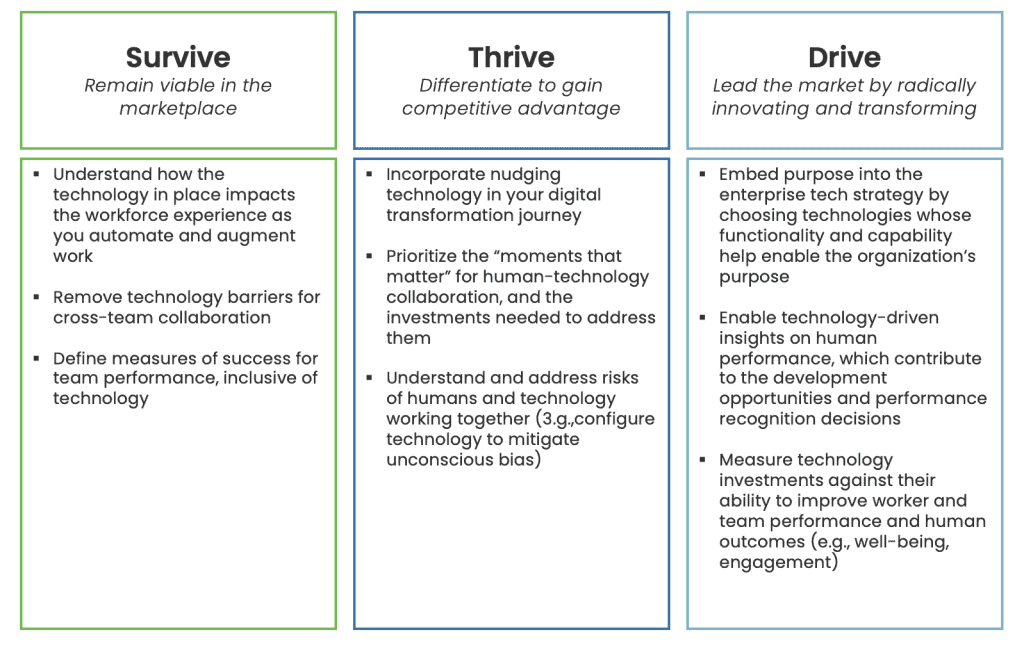
As we move from the information age to the imagination age, technology is evolving from helping workers produce outputs to enabling humans and teams to focus on outcomes. These outcomes have downstream effects on customers, product quality, site safety, the environment, and beyond. Realizing this value requires organizations to move away from outdated views of technology as a productivity enhancer and embrace the potential of intelligent technologies to enable human and team impact, powered by technology.
Invest in Cross-Functional Relationships
In today’s interconnected world, success often depends on the ability to collaborate across departments and functions. L&D leaders can play a crucial role in fostering these relationships by creating opportunities for employees to work together on projects and initiatives.
By bringing people together from different areas of the business, L&D can help break down silos and promote a culture of collaboration. This can lead to more innovative solutions, better decision-making, and a stronger sense of community within the organization.
Improve Your Data Literacy
As businesses become more data-driven, it’s essential for L&D leaders to improve their data literacy skills. This means understanding how to collect, analyze, and interpret data to make informed decisions.
By developing data literacy skills, L&D leaders can better understand the impact of their programs and initiatives. They can use data to identify areas for improvement, measure the effectiveness of training, and make data-driven decisions about future investments.
Additionally, data literacy can help L&D leaders communicate the value of their programs to stakeholders across the organization. By presenting data in a clear and compelling way, L&D can demonstrate the impact of their work and build support for future initiatives.
Conclusion
Embracing an intelligent content strategy, doing more with less, and gaining visibility into content performance and data/analytics are essential in today’s fast-paced world. Investing in a LCMS can help organizations improve teamwork and collaboration, enhance personal capabilities, and keep pace with future trends in the workplace. By embracing intelligent technologies, such as an LCMS, organizations can empower their workforce to focus on outcomes and achieve greater success in the imagination age.
See how MadCap Create, MadCap’s learning content management system, helps L&D teams author, manage, and deliver intelligent content from a single source.
Frequently Asked Questions
What is a learning content management system (LCMS)?
A learning content management system (LCMS) is a platform that integrates the authoring, management, delivery, and analysis of learning content in a single, multi-user environment. It lets teams create modular, reusable content once and publish it across multiple channels and formats.
What is the difference between an LCMS and an LMS?
An LCMS focuses on creating, managing, and reusing learning content, while a learning management system (LMS) focuses on delivering courses and tracking learner progress. Many organizations use both: the LCMS to build and maintain content, and the LMS to assign it and measure completion.
Why should organizations invest in an LCMS?
An LCMS helps L&D teams do more with less by centralizing content creation, improving collaboration, reusing content across courses, and providing analytics on content performance. That efficiency matters as the corporate training market is projected to nearly double to $805.6 billion by 2035.
How does an LCMS help teams do more with less?
By storing content as reusable components and automating publishing, an LCMS reduces duplicate work and administrative effort. Teams update content once and it flows everywhere it is used, freeing time for higher-value work such as strategy, design, and analysis.