

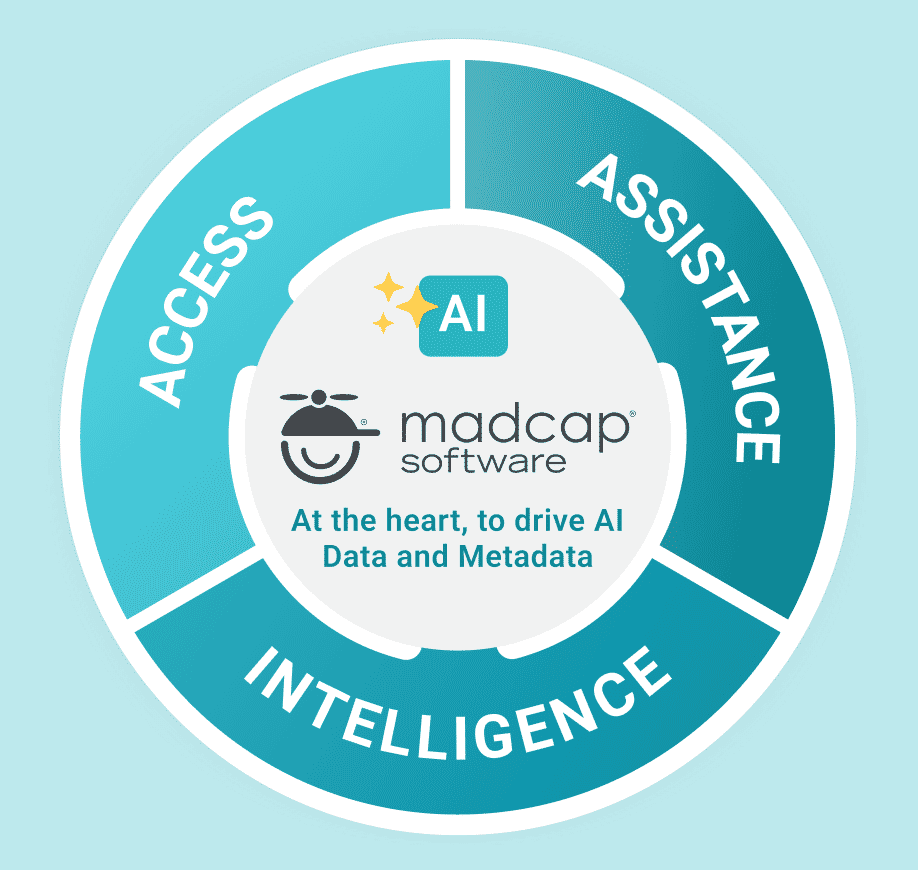




AI content management is the practice of organizing, structuring, and governing content so AI systems can retrieve, interpret, and use it accurately. It rests on three pillars: Content Access, Content Intelligence, and Content Assistance. Getting there starts with AI-ready content, content that is structured and tagged for machines as well as people.
- Content Access: making sure AI can retrieve the right information.
- Content Intelligence: turning content into analyzed, structured insight.
- Content Assistance: using AI to help create and refine content.
AI is revolutionizing content creation, management, and distribution—making information more accessible, accurate, and adaptable. Yet, many organizations struggle to realize its full potential. Why? Because AI doesn’t inherently understand proprietary knowledge—it depends on structured, high-quality content to deliver meaningful insights.
This was a central theme in MadCap Software’s 4-part AI webinar series, where industry experts emphasized that AI is only as effective as the content ecosystem it operates within. Without well-structured, centralized, and governed content, AI risks delivering outdated, misleading, or irrelevant results.
So, how can organizations ensure AI drives real value? By focusing on three core pillars: Content Access, Content Intelligence, and Content Assistance—each playing a critical role in how AI retrieves, analyzes, and enhances content.

Content Access: Ensuring AI Can Retrieve and Use the Right Information
Content access means giving AI direct, governed access to your internal content so it can answer from verified sources. Without it, AI either guesses or returns generic results.
The Challenge: AI Can’t Use What It Can’t Access
AI models, including large language models (LLMs), are trained on vast datasets, but they don’t automatically understand an organization’s proprietary knowledge base. Without direct access to structured internal content, AI can’t provide reliable, context-aware answers—it will either fabricate information or offer generic responses. This is why it’s critical to prepare content for AI. By ensuring that your content is well-organized and accessible, AI can pull from the right sources, providing more accurate, relevant, and actionable insights. For the foundations, see how to build structured content for AI.
A common scenario is employees searching for updated policies or training materials, only to receive irrelevant or outdated results because the AI hasn’t been given access to verified internal documentation. This is where Retrieval-Augmented Generation (RAG), an AI framework that enhances generative models, becomes essential.
How Retrieval-Augmented Generation (RAG) Prevents AI Hallucinations
RAG retrieves relevant, verified content from your internal repository before generating a response, instead of relying on the pretrained model alone. That grounds answers in real content and prevents hallucinations. For the full walkthrough, see our guide to preparing content for RAG.
AI-Powered Access in Action: MadCap Create, MadCap Flare , MadCap IXIA CCMS, and MadCap SyndicateAI
To unlock the full potential of RAG and AI-powered search, organizations must first structure their content in a way that allows for seamless retrieval. This process starts with MadCap Create (formerly Xyleme LCMS) and MadCap Flare, which serve different content authoring needs:
- MadCap Create focuses on eLearning and instructional content, ensuring that training materials are metadata-tagged, structured, and AI-ready.
- Flare is designed for technical documentation, policies, and help guides, enabling structured authoring for multi-channel publishing.
Once content is structured, MadCap Create and Flare push it into MadCap SyndicateAI’s content delivery platform, where it benefits from:
- AI-powered retrieval, enhanced metadata tagging, and semantic search.
- Syndication across enterprise search engines, knowledge bases, and AI-powered tools.
- Centralized content governance, ensuring consistency across learning and technical documentation.
By integrating MadCap Create and Flare with MadCap SyndicateAI, organizations ensure that both training content and technical documentation are AI-ready, easily retrievable, and properly indexed for semantic search.
Content Intelligence: Turning Content into Strategic Insights
Content intelligence is the use of AI to analyze a content set and surface what is valuable, outdated, or duplicated, so teams can curate and optimize their knowledge base with data.
AI doesn’t just improve content access—it transforms how organizations analyze, structure, and optimize information. Without AI-driven insights, many companies struggle with content overload, where employees waste time searching through duplicate, outdated, or buried materials.
This lack of visibility creates content chaos, with teams unknowingly recreating resources or missing critical gaps. AI-driven content intelligence solves this by identifying which content is valuable, outdated, or redundant, helping organizations curate, refine, and optimize their knowledge base with data-backed decisions.
However, insight alone isn’t enough—organizations also need a way to ensure this content remains well-structured and easy to surface when needed.
Content Search, Tagging, and Classification
AI improves search by understanding intent, not just exact keywords, and it tags and classifies content automatically so it stays easy to find.
Traditional content search relies on exact keyword matches, making it difficult for users to find content if they don’t use the right phrasing. AI-powered semantic search improves this by understanding intent, retrieving relevant materials even when queries don’t precisely match document titles or metadata.
AI also enhances content clustering, automatically grouping related materials by themes, topics, or context. This helps organizations:
- Identify patterns across large content sets.
- Reduce redundancy by consolidating duplicate materials.
- Improve content discoverability by linking similar resources.
Beyond clustering, AI automates content classification, assigning structured categories and metadata to ensure content is easy to retrieve and manage. AI-driven classification helps organizations:
- Apply metadata at scale for better searchability.
- Maintain consistency in how content is labeled across repositories.
- Automatically categorize content based on context and intent.
However, to fully harness AI-driven search, clustering, and classification, organizations need a structured content ecosystem that ensures content remains accessible, well-organized, and AI-ready.
MadCap Solutions for AI-Driven Content Intelligence
While MadCap Create, Flare, and IXIA CCMS (a component content management system (CCMS)) structure content at the authoring stage, MadCap SyndicateAI refines it further—enhancing metadata tagging, enabling AI-powered search, and optimizing content for discoverability across enterprise platforms. Key capabilities of MadCap SyndicateAI include:
- Semantic search, which allows AI to retrieve relevant content based on intent rather than exact text matches.
- Metadata tagging, helping organizations organize and classify content for better searchability and retrieval.
- Content usage analytics, providing insights into how content is being accessed and interacted with.
As part of ongoing AI enhancements, MadCap AI Lab (MadCap’s research and development space for AI-driven features) is refining additional capabilities, including:
- AI-powered metadata tagging, which will automate content classification upon ingestion, ensuring consistency and reducing manual effort.
- Advanced semantic analysis and vector-based retrieval, enabling AI to identify deeper content relationships and improve knowledge discoverability.
- Duplicate content analysis, aimed at identifying and consolidating redundant materials to streamline content ecosystems.
With structured, AI-ready content in place, the next step is leveraging AI to assist in content creation and refinement—helping teams work more efficiently without compromising accuracy or control.
Content Assistance: AI as a Co-Pilot for Content Creation
Content assistance uses AI to help writers draft, summarize, and refine content faster, without giving up editorial control or governance.
For many organizations, the challenge isn’t just finding and organizing content—it’s also creating, refining, and maintaining it at scale. AI is reshaping workflows, not by replacing writers or instructional designers, but by accelerating repetitive tasks so teams can focus on strategy, creativity, and precision. See how this is changing the role of AI for technical writers.
Instead of struggling with blank-page syndrome or spending hours manually formatting content, AI helps teams generate, refine, and optimize materials efficiently while ensuring governance and brand consistency.
AI-Powered Content Optimization with MadCap Sidekick and MadCap Central
As AI becomes a core tool in content workflows, on-demand assistance is no longer a convenience—it’s essential for streamlining creation, refinement, and optimization. To support this, MadCap Software has embedded AI-driven capabilities directly into MadCap Sidekick and MadCap Central, helping teams boost efficiency while maintaining editorial control. For setup details, see the MadCap Central AI Assist documentation
- MadCap Sidekick offers an extensible AI toolkit, enabling teams to summarize content, generate assessments, and refine documents using customizable AI-powered actions.
- AI Assist in MadCap Central integrates ChatGPT-based AI capabilities into cloud authoring workflows, enabling drafting, rewriting, and refinement with user-enabled security controls.
Scaling Structured Content with MadCap IXIA CCMS
While AI enhances everyday content workflows, it also plays a critical role in managing structured documentation at scale. Large enterprises often struggle to maintain consistency across thousands of documents, ensuring technical content remains clear, searchable, and compliant.
For organizations handling highly structured content, MadCap IXIA CCMS leverages AI through its Positron plugin to streamline content creation and editing workflows. Rather than relying solely on manual authoring, Positron provides predefined AI-assisted actions, enabling users to efficiently rewrite, summarize, and refine technical documentation. This ensures content remains well-organized, consistent, and easy to update—particularly in industries where precision and regulatory compliance are critical.

Security & Governance: Keeping AI in Check
Strong content governance keeps AI adoption secure: teams control which content AI can access, which models it uses, and who can use it.
As organizations increasingly rely on AI for content creation and management, security, privacy, and governance must remain top priorities. AI introduces powerful efficiencies, but without proper safeguards, it can pose risks to proprietary and sensitive information.
MadCap’s approach prioritizes secure, controlled AI adoption, ensuring organizations maintain full authority over how AI interacts with their content. Key security measures include:
- Opt-in AI Features – AI Assist does not automatically process entire documents. Users must explicitly enable AI interactions and select specific content to process, rather than allowing AI unrestricted access.
- Support for Private AI Models – Organizations have the option to integrate their own private ChatGPT accounts, preventing proprietary content from being stored in public AI systems.
- Strict API Control & User Permissions – AI Assist requires an OpenAI API key, ensuring only designated content is processed. Additionally, organizations can enable or restrict AI Assist usage at the user level to maintain strict content governance.
AI-Driven Success Starts with an AI Content Strategy
An AI content strategy is a plan for structuring, governing, and maintaining content so AI tools can use it reliably across the content lifecycle. It aligns authoring, metadata, and delivery around making content AI-ready.
AI isn’t just a tool—it’s a transformation. But its impact is only as powerful as the content behind it. Without well-structured, intelligently managed content, even the most advanced AI can fall short.
That’s why MadCap’s approach isn’t about adding AI for the sake of it—it’s about embedding AI into structured content workflows to drive efficiency, discoverability, and long-term scalability. MadCap Create and Flare provide the foundation for structured content authoring, while MadCap SyndicateAI, MadCap Sidekick, IXIA CCMS, and AI Assist in MadCap Central optimize every stage of the content lifecycle—from creation and management to retrieval and automation.
AI will continue to evolve, but one thing remains constant: your content is the foundation. Those who invest in structured, AI-ready content today won’t just keep up—they’ll lead the future of intelligent content management.
Frequently Asked Questions
What is AI content management?
AI content management is the practice of organizing, structuring, and governing content so AI systems can retrieve, interpret, and use it accurately. It spans content access, content intelligence, and content assistance, and it depends on structured, well-tagged source content rather than the AI model alone.
What is an AI content management system?
An AI content management system is software that structures, tags, and delivers content so AI tools can search and use it reliably. It combines structured authoring, metadata, and governed delivery so generative AI returns accurate, source-grounded answers instead of generic or fabricated ones.
How does AI improve content management?
AI improves content management in three ways: it retrieves the right content through semantic search, it analyzes content to find gaps and duplicates, and it assists writers by drafting and refining. Each depends on structured, governed source content to work accurately.
How do I prepare my content for AI?
Prepare content by structuring it, tagging it with consistent metadata, and governing it centrally so AI can find and trust it. Structured authoring and a single source of truth let tools such as Retrieval-Augmented Generation ground answers in your verified content.
How is AI content management different from traditional content management?
Traditional content management organizes content for people to find and read. AI content management adds structure, metadata, and governance so machines can also retrieve and reason over it. The shift is from human-readable storage to machine-usable, AI-ready content.
What is content intelligence?
Content intelligence is the use of AI to analyze a content set and surface what is valuable, outdated, or duplicated. It helps teams curate and optimize their knowledge base with data, reducing content overload and the risk of recreating material that already exists.
Watch the full AI webinar series
Episode 1: Preparing for AI in Content Development and Management
Episode 2: Content Access
Episode 3: Content Intelligence
Episode 4: Content Assistance