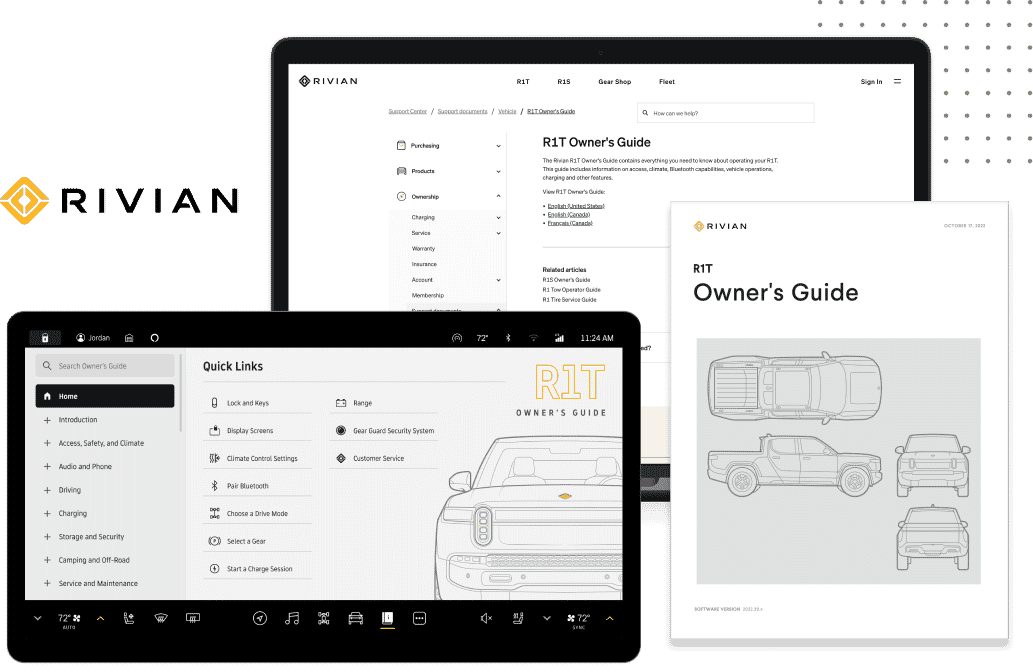







Content personalization has become the aspiration of modern communications. Enterprises large and small are on a quest to deliver the content a customer needs — and only that content — at the current part of the customer’s journey.
Nothing more and nothing less.
Marketing communications, human resources, training, technical documentation, and customer support are all looking to deliver content that is relevant, usable, and timely.
They want to deliver:
- The right content
- To the right person
- At the right time
- On the right device
- In the language of their choosing
Our industry has been trying to achieve this goal for a long time. So why isn’t it happening, successfully, at scale?
Two Ways to Provide Personalization
There are two ways to go about delivering personalized content.
The first way is manual. This method means that you create, manage, store, update, and retire different content for each person, persona, or customer type. Many enterprises have tried, and failed, to deliver personalized content in this way. The entire concept of creating personas and then writing content for each person represents an often-failed attempt at personalized content. It simply doesn’t scale.
The second way is automated. This method emphasizes sophisticated tools that attempt to match the content to the consumer.
Some enterprises have tried this method. They’ve invested time, money and resources into adopting new technologies. They may have worked hard to deliver a proof of concept with a limited set of content and customer data.
The problem is, they didn’t first optimize the content for reuse, automation, or personalization. They took existing content and put it into new tools and hoped that would be enough.
But it’s not.
Personalize at Scale
The only way to deliver personalized content at scale is to automate the process at the point of delivery. And for that to work, you’ve got to change how you “do” content.
Instead of creating (storing, managing, retiring) an entire information asset for a particular person or persona, you need to reuse components from a comprehensive library of chunked information. The content must be written, stored, managed, and retired using small format-free components that can be dynamically assembled, published, and delivered on the fly.
And herein lies the Personalization Paradox.
To provide personalized experiences at scale, the content must be standardized.
In order to create nimble, reusable pieces of content that can be combined, on the fly, in different ways for different people and different devices, you must standardize everything about the content.
This includes the words and images you use, the ways in which you combine them, the tone and voice, and ultimately the paragraphs and sets of paragraphs that you deliver. If you do not standardize your content, you will not be successful combining various components in different ways.
Sure, you can deliver words, sentences, and paragraphs. But that doesn’t mean they will fit together seamlessly to create a customer experience that reflects your brand.
Standardization Enables Personalization
Standardization enables personalization.
Without standards, any attempt to deliver personalized experience is hampered by content that does not flow when the consumer encounters it. It sends mixed messages. It creates confusion instead of providing clarity.
By using standards, your content can mix-and-match seamlessly. It is uniform in terminology, tone, grammar, and style. Components are tagged with rich metadata, so that systems and people can find them. Components are stored in a content management system where content is easy to find, assemble, and release to the personalization engine and delivery platforms.
The Personalization Paradox seems to elude many organizations. They do not understand that even the latest, most sophisticated technology is not enough on its own to produce a professional, personalized experience. They must also change the way they envision, create, manage, store, and retire the requisite components.
Standardizing content to create a personalized experience might seem counter-intuitive at first. After all, when we think of a personalized experience, we think of unique content that is created and delivered for a unique individual. As we have seen, creating unique content this way simply cannot scale.
Now what?
According to several studies released in the past year, most enterprises say that personalizing the customer experience is a critical “must have,” and they have the statistics to back it up. And yet, very few enterprises believe they are delivering enough personalized content or delivering it well.

In this book, global content strategy expert Val Swisher and senior content strategist Regina Lynn Preciado show you exactly what it takes to deliver personalized experiences at scale.